
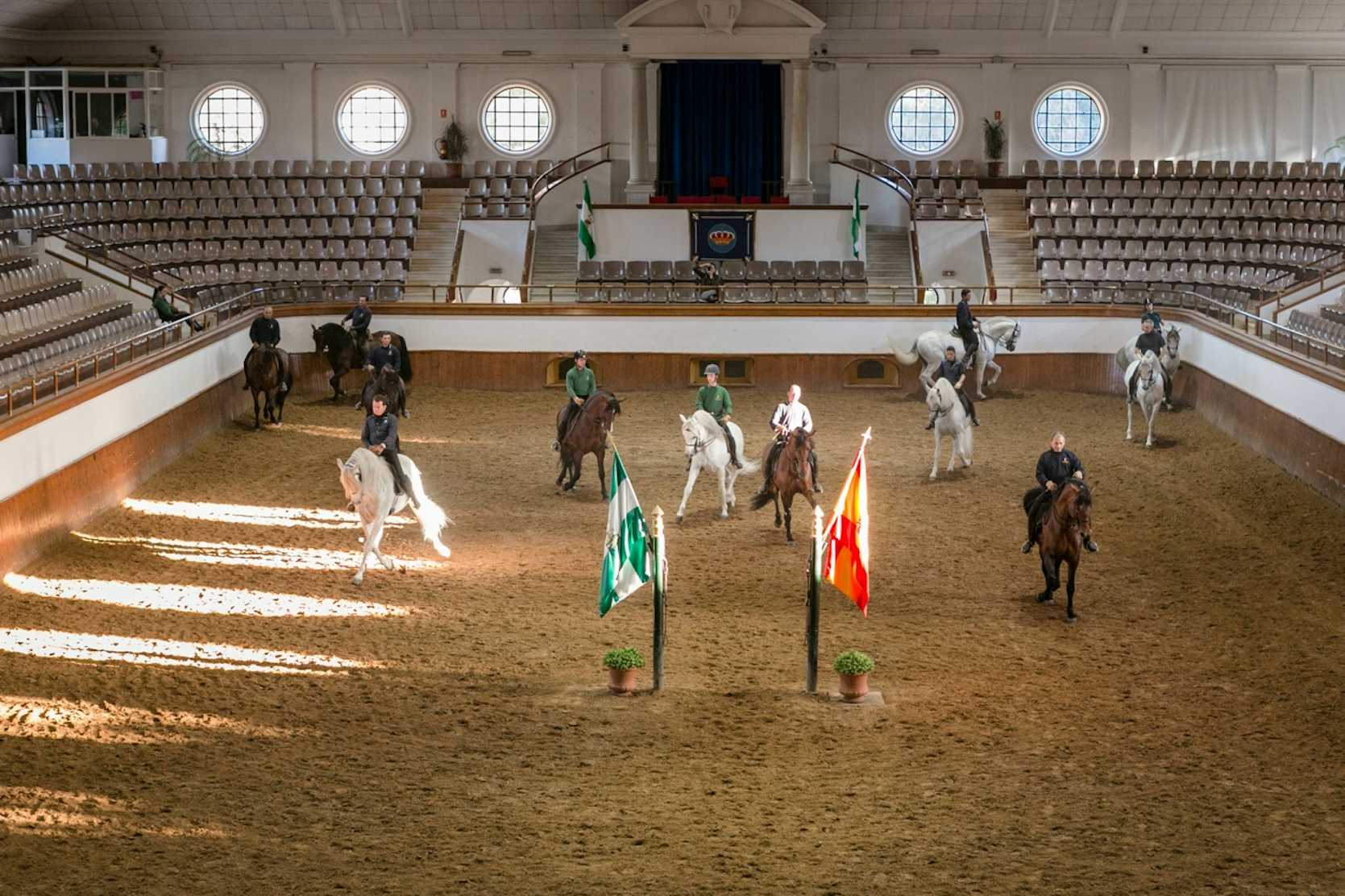
Royal Andalusian School of Equestrian Art, Jerez de la Frontera
I still remember the first time I saw an Andalusian horse move in perfect sync with a rider in Jerez de la Frontera. The animal didn’t just trot. It danced. That moment rewired my understanding of what Spanish culture actually means.

Michael Madsen shares tips for experiencing the Andalusian horse with you
Seeing a pura raza española perform is not a side attraction. It’s the main event. The Royal Andalusian School of Equestrian Art alone stages shows with six to eight different choreographies, blending classical dressage, Doma Vaquera, and carriage driving into one seamless equestrian ballet. If you want to understand Andalusia, start with its horses.
My answer is simple: plan your trip around a live performance, not a postcard. The Andalusian horse is certified as a unique breed, and watching one execute a levade or a Spanish walk in an 18th-century arena beats any museum visit. No contest.
Here’s what I’ll walk you through:
- The sandy streets of El Rocio, where horses have priority over cars and people
- The Royal Andalusian School of Equestrian Art in Jerez, including the full visit and VIP upgrade
- The flamenco-infused show in Cordoba’s 16th-century Royal Stables
- Club Hipico El Ranchito near Malaga, where 20 horses star in an equestrian ballet
- A countryside spectacle in Cadiz with Torrestrella bulls and Alvaro Domecq horses
- The Yeguada de la Cartuja stud farm, home to more than 200 Carthusian horses
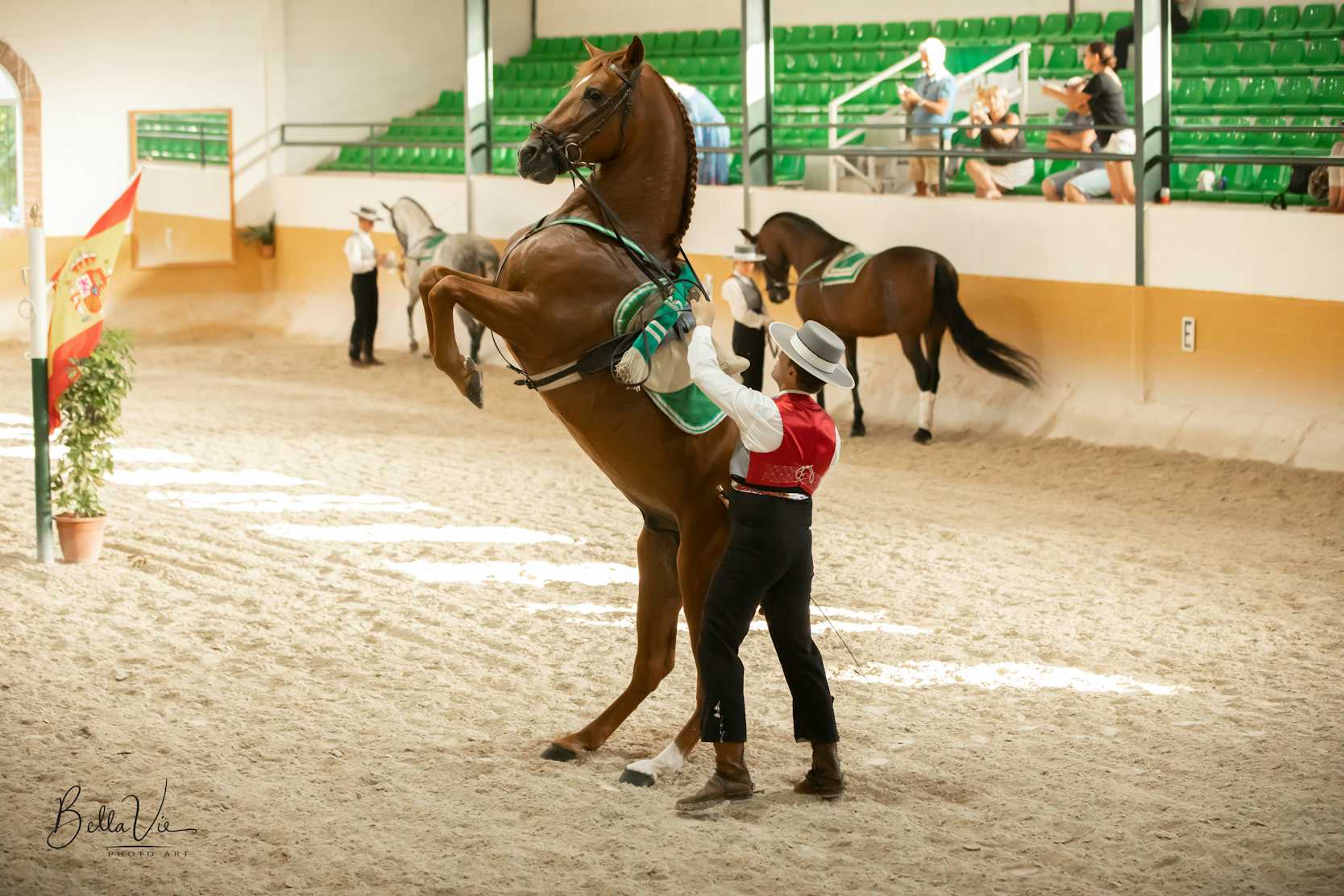
Club Hipico El Ranchito, Torremolinos
I’ve spent years chasing these performances across Andalusia. The dust, the music, the smell of leather and hay. It never gets old. And once you see a stallion break into an arreon at full gallop, you’ll understand why I keep going back.
Riding horses in the sandy streets of El Rocio
Decide whether you want to watch horses perform or actually live among them. If it’s the latter, El Rocio is the only place in Spain where the Andalusian horse isn’t a spectacle-it’s simply how people get around. The village has no paved roads, just deep sand, and every whitewashed house has wooden bars out front for tethering horses.
You park the car, tie up the horse, and walk inside. That’s the whole system.
What strikes me most is how the architecture bends around the animal. Verandas shade the hitching posts. Doorways sit high enough for a mounted rider to pass.
Nobody designed this for tourists. It evolved because, for generations, arriving on horseback was the normal way to show up.
Here’s what you’ll notice within five minutes of arriving:
- Horses have right of way over cars, bicycles, and pedestrians-always
- Riders wear cowboy boots and traditional traje corto, not riding helmets
- Women in flamenco dresses ride sidesaddle or travel in horse-drawn carts
- The sand muffles everything, so the loudest sound is often hooves and harness bells
Horse riding in Spain is, to a wide extent, a male passion. Unlike most of Europe, you’ll see far more men than women in the saddle at any feria. That’s not a rule-it’s just how the culture shaped itself around cattle work and doma vaquera. I’ve watched teenage boys handle stallions with a calm that would terrify most adult riders elsewhere.
The Romería is when El Rocio truly becomes what it was built for. Held 50 days after Easter, it draws pilgrims on horseback, in carts, or on foot, all wearing traditional flamenco dress. No one lives in the village permanently, but during the pilgrimage it fills with thousands of people and animals. Religion and fiesta blur together completely.

Riding horses in the streets of El Rocio
Just beyond the village, the Doñana wetlands hold large flocks of grazing horses. Seeing them there, half-wild against the marsh grass, you understand why the pura raza española carries such cultural weight. It’s not a show breed pretending to be rustic. It’s a working animal that happens to move beautifully.
See also my article about El Rocio here.
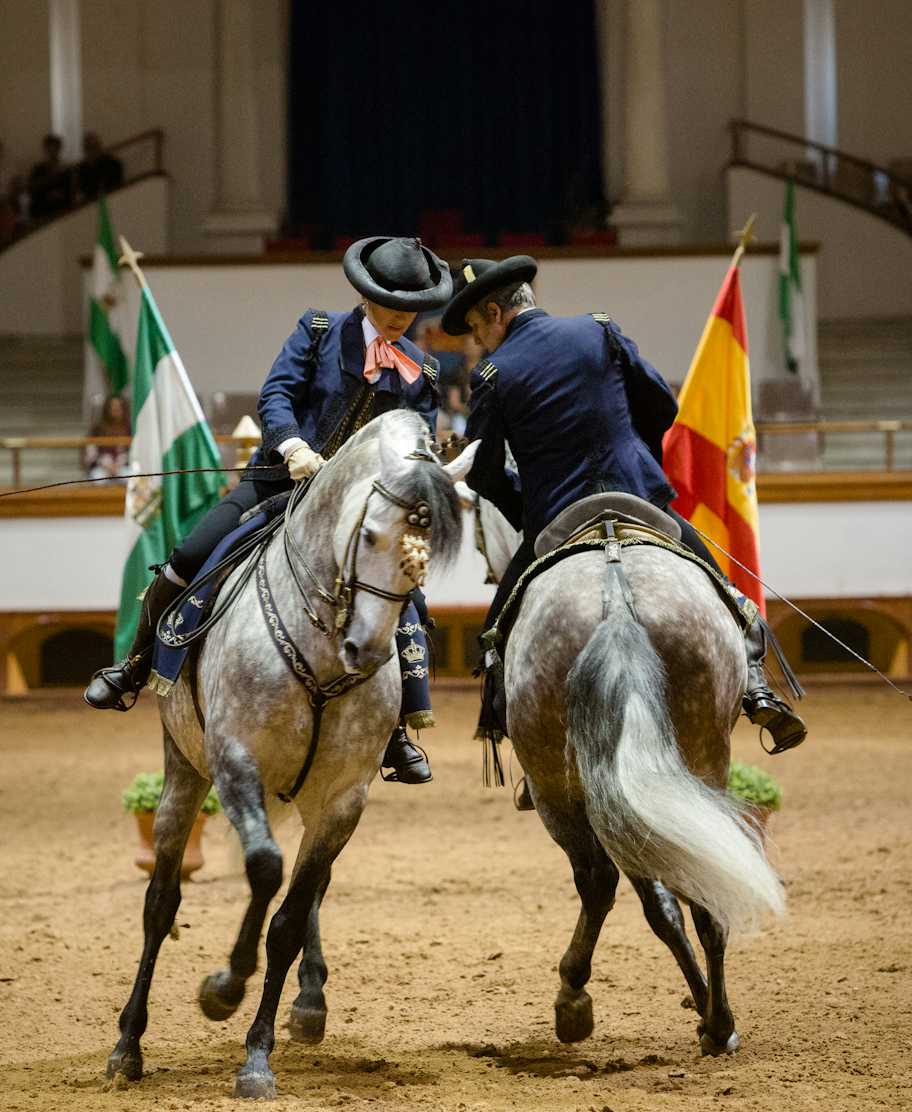
Royal Andalusian School of Equestrian Art, Jerez de la Frontera
Royal Andalusian School of Equestrian Art: Andalusian Horse Show
The “How the Andalusian Horses Dance” show in Jerez de la Frontera is a 90-minute equestrian ballet featuring six to eight choreographies that blend Classical Dressage, Doma Vaquera, carriage driving, and Haute École work set to 18th-century-inspired music and costumes.
I’ve sat through dozens of equestrian performances across Spain, and nothing prepares you for the precision inside that arena. The moment the first stallion enters to classical Spanish music, you realize this isn’t a show about tricks. It’s a living archive of riding disciplines that have shaped Andalusian culture for centuries.
The choreography draws from three distinct traditions. Classical Dressage has horses executing advanced exercises in perfect rhythm with the orchestra. Doma Vaquera is the cowboy discipline – riders work with one hand, shifting from trot to gallop, then snapping into pirouettes and arreones, those sudden bursts into full speed that mimic cutting cattle. The third source is simpler: everyday stable chores, elevated into art.
The Disciplines You’ll See
Each performance rotates through six to eight choreographies, but the core elements remain consistent. Here’s what unfolds:
- Classical Dressage: Advanced exercises performed to classical music, where horse and rider move as one organism.
- Doma Vaquera: One-handed riding based on cattle herding, featuring pirouettes and explosive gallops.
- Carriage Driving: Coachmen demonstrate the dexterity required to maneuver horse-drawn carriages with precision.
- Work in Hand: Horses perform without any physical connection to humans – levades, caprioles, courbettes, piaffe between pillars, the Spanish walk, and long reins.
- Carousel: A group of horses and riders executing advanced exercises in unison, a fitting finale.
The Work in Hand section is where I always hold my breath. Watching a stallion rise into a perfect capriole – all four hooves leaving the ground, hind legs kicking out – feels like gravity briefly stops working. That moment stays with you long after the arena empties.
Why It Matters
The costumes and music aren’t decoration. They anchor the performance in the 18th century, when the pura raza española was being refined as a breed. What you’re watching is a direct line to that history, performed by horses whose bloodlines trace back to those same stables.
The full visit to the Royal School – the stables, the training sessions, the palace – adds another layer entirely. But the show itself is the definitive statement of what this breed can achieve.
What Does a Full Visit to the Royal Andalusian School of Equestrian Art Include?
A full visit combines a training session in the indoor arena with self-guided access to the palace, gardens, museums, and carriage collection. The optional VIP upgrade adds a 2-hour guided tour and closer access to the training forecourt.
I’ve watched the evening performance enough times to know the choreography by heart. But the morning training session is a different animal entirely. No costumes, no music, no theatrical lighting. Just a trainer in work clothes, a horse learning a new sequence, and the quiet repetition that makes the impossible look effortless later.
That’s the real value of the standard ticket. You see the process, not the product.
What the Standard Visit Covers
The self-guided route takes you through the Recreo de las Cadenas, which includes the harness workshop, the palace, and the gardens. I spent twenty minutes alone in the harness workshop, watching leatherworkers stitch bridles by hand. The smell of saddle soap and fresh leather stays with you.
From there, the Museum of Equestrian Art and the Carriage Museum round out the historical picture. The carriages are the surprise. Some are ornate enough to belong in a royal wedding; others are working vehicles with worn axles and cracked varnish. Both tell the truth about how horses shaped daily life here.
A guided visit to the stables and saddlery is available in selected languages. Take it if you can. The guides know which stallions are in training and which ones are retired, and they’ll point out details you’d miss on your own.
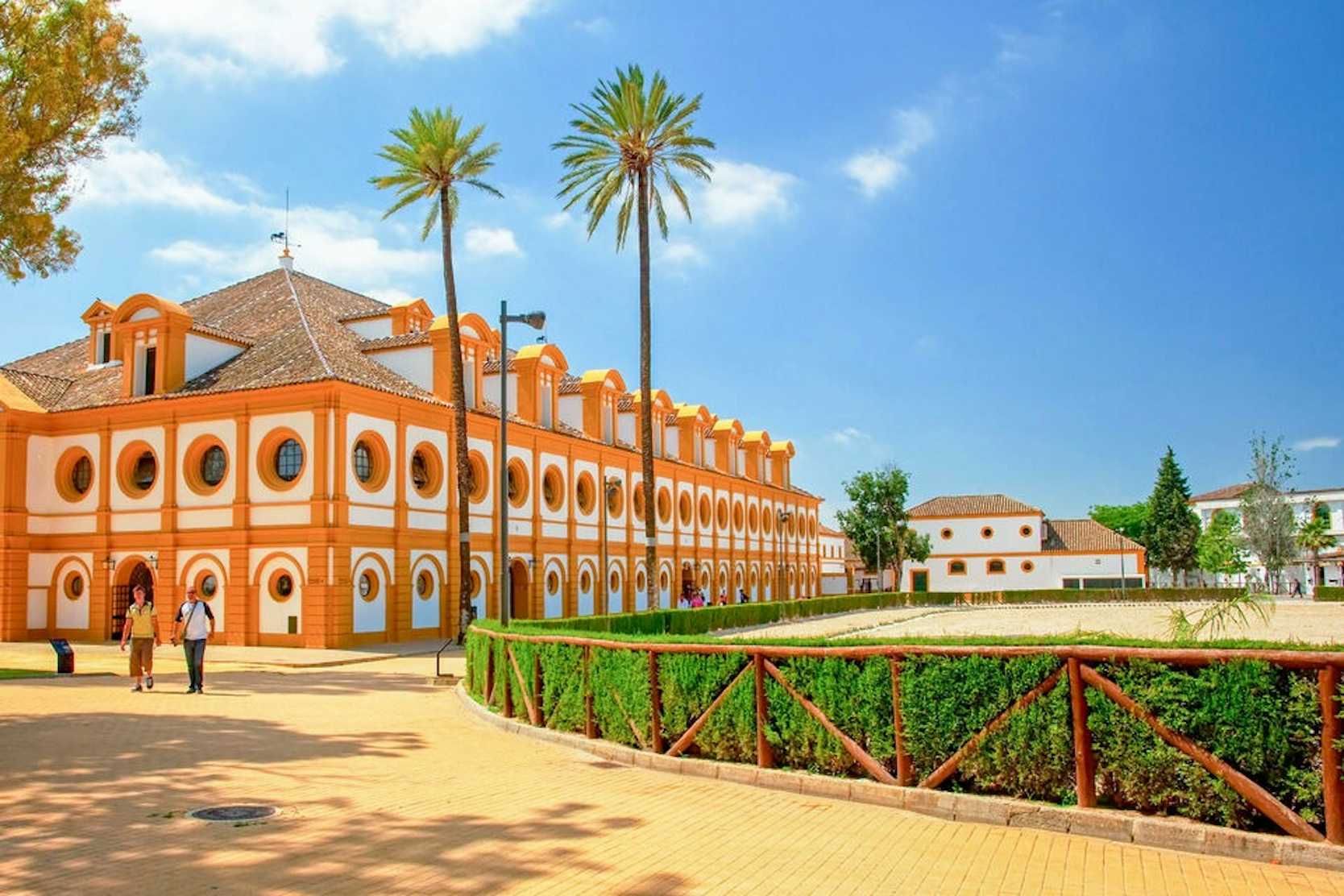
Royal Andalusian School of Equestrian Art, Jerez de la Frontera
Is the VIP Upgrade Worth It?
The VIP ticket adds an audiovisual screening and an exclusive 2-hour guided tour of the palace halls, saddlery, stables, tack room, and museums. But the real draw is standing on the arena’s forecourt during training sessions.
That’s the difference. From the forecourt, you’re close enough to see the trainer’s hand shift on the rein, the horse’s ear flick toward a command, the exact moment a movement clicks. From the standard seating, you see the shape of the exercise. From the forecourt, you see the conversation.
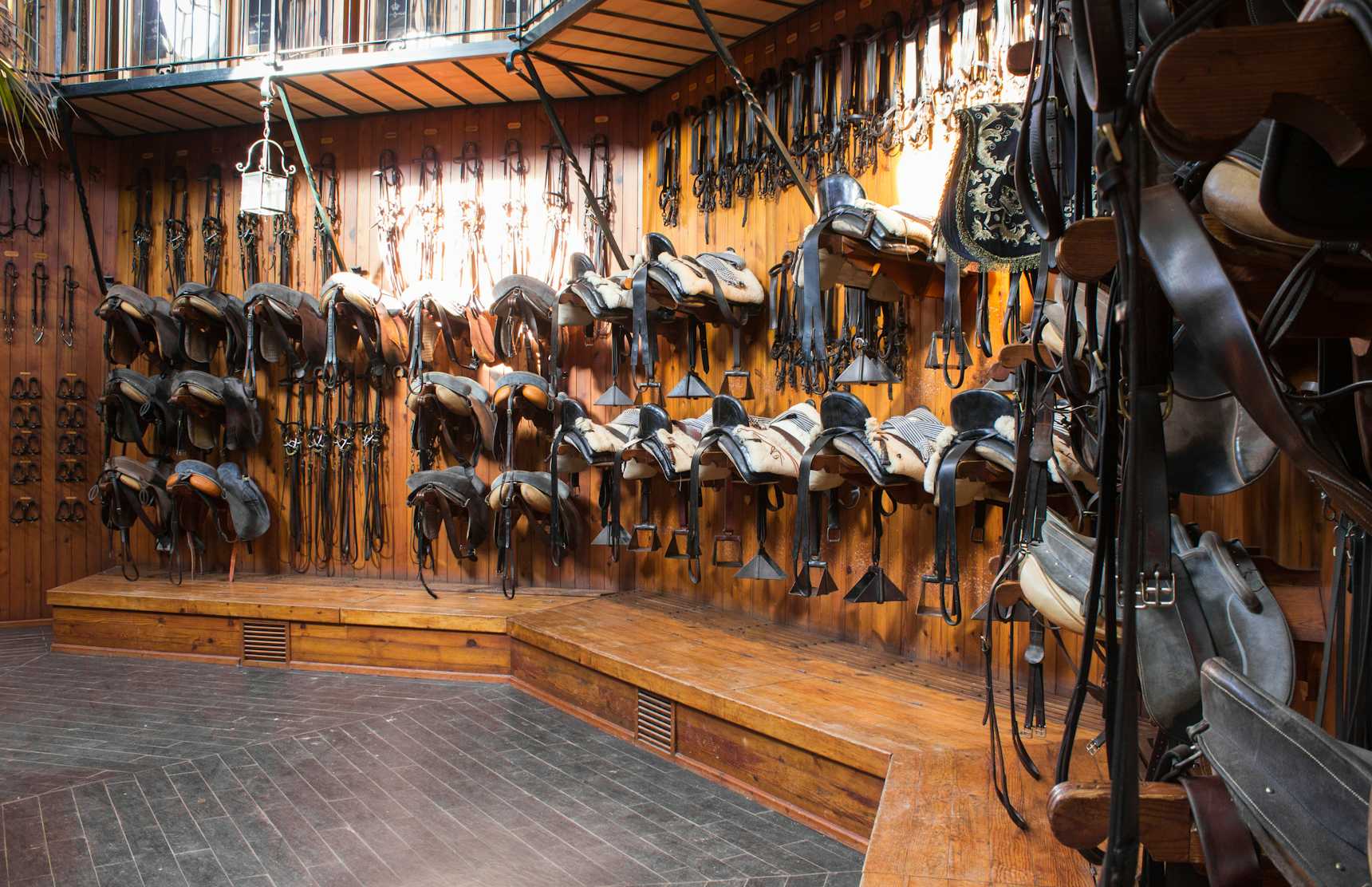
Royal Andalusian School of Equestrian Art, Jerez de la Frontera
Here’s what I’d weigh:
- Standard ticket: training session, self-guided palace and gardens, both museums, optional stables tour. Solid half-day.
- VIP ticket: everything above, plus the screening, the 2-hour guided tour, and forecourt access during training. A deeper, slower experience.
If you’re already in Jerez for the show and want to understand the institution behind it, the standard visit does the job. If you’re the kind of person who asks trainers questions and lingers at stall doors, the VIP upgrade earns its price.
I’ve done both. The standard visit taught me the history. The VIP visit taught me the patience. Watching a horse learn a levade from three meters away, seeing the trainer correct a shoulder angle with a whisper and a touch, that’s the dedication the evening performance only hints at.
Other equestrian shows across Andalusia offer their own flavor, but none of them let you this close to the training floor.
What Is the ‘Passion and Spirit of the Andalusian Horse’ Show in Cordoba?
The ‘Passion and Spirit of the Andalusian Horse’ is a 70-minute performance in Cordoba that fuses classic dressage, cowboy dressage, and high school dressage with live flamenco dancing, all set against the 16th-century Royal Stables of Cordoba.
The 80/20 rule applies here – most equestrian shows give you 80% horse and 20% atmosphere. This one flips the ratio. I’ve sat through enough dressage exhibitions to know when a performance is just going through the motions, and this isn’t that.
A flamenco dancer doesn’t simply accompany the horse; she mirrors its energy with intricate footwork while the stallion executes precise high school movements. That synchronized artistry is the whole point.
What makes it work is the venue. The Royal Stables of Cordoba were constructed in the 16th century, and the stone arches and open courtyard do something to the acoustics that a modern arena can’t replicate. The horse’s hooves echo.
The dancer’s heels crack against the floor. It feels less like a show and more like you’ve wandered into something private.
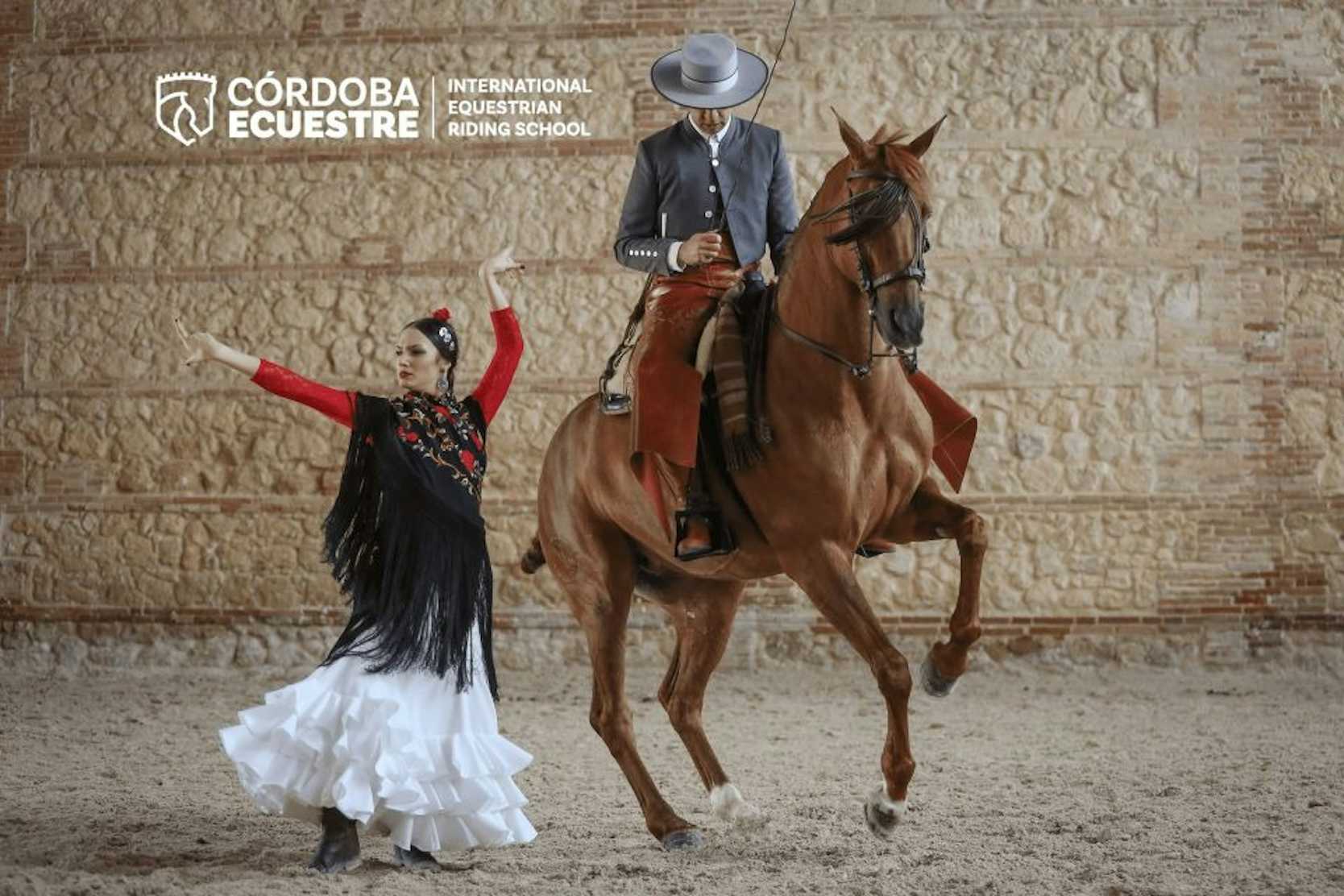
Córdoba Ecuestre. International Equestrian Riding School.
Here’s what the 70 minutes actually includes:
- Classic dressage sequences performed by Andalusian horses
- Cowboy dressage elements drawn from traditional cattle work
- High school dressage movements like levades and piaffe
- Live flamenco dancing that responds to the horse’s rhythm
- Period-inspired costuming that ties the two art forms together
I’ll be blunt: if you’ve already seen the Jerez show, you might think you’ve checked the Andalusian horse box. You haven’t. Cordoba adds a layer of emotional rawness that pure classical dressage sometimes lacks. The flamenco isn’t decoration – it’s a conversation between two performers who understand tension and release.
That fusion matters because it proves the Andalusian horse can adapt to regional identity. Other shows across Andalusia lean into local traditions too, but this one does it with genuine artistic intent rather than tourist gloss. The horse remains the star, yet the dancer makes you feel the music in your chest.
Skip the back rows. Sit close enough to see the horse’s muscles tense before a levade, and you’ll understand why Cordoba’s version of this spectacle stays with you long after the final stamp of a flamenco heel.
Club Hipico El Ranchito: Andalusian Horse and Flamenco Show
Club Hipico El Ranchito in Torremolinos stages Ritmo a Caballo, an equestrian ballet that has run for over 25 years and stars 20 horses trained entirely by their own riders. It’s the Malaga coast’s longest-running horse spectacle, and it leans harder into entertainment than any dressage purist would admit.
Here’s what most people get wrong about this show. They assume longevity means museum-piece stiffness. They picture a dusty arena with tired routines.
That’s not what happens. The riders and amazonas wear authentic old Andalusian costumes, and the whole thing moves at a pace that feels closer to a fiesta than a formal exhibition.
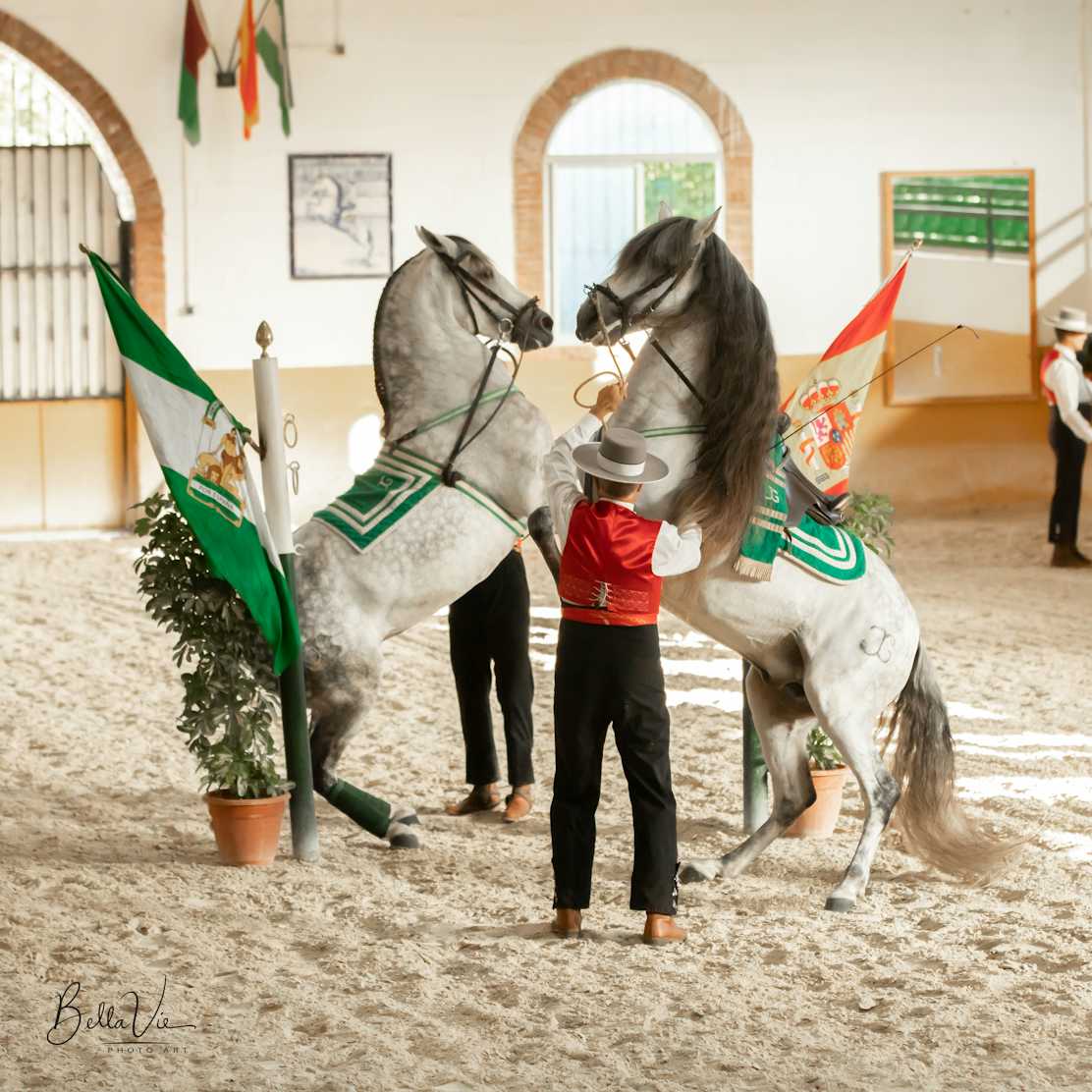
Club Hipico El Ranchito, Torremolinos
The format breaks down like this:
- 20 horses, each trained by the person riding them – no hired guns, no borrowed mounts
- Cowboy moves mixed with classical dressage, all set to Spanish music
- Riders and amazons in period Andalusian dress, not modern show jackets
- Over 25 years of continuous performance at the same venue
I’ve sat through enough equestrian shows to know the difference between precision and personality. Ritmo a Caballo has both, but it refuses to take itself too seriously. The cowboy sequences would make a Doma Vaquera traditionalist raise an eyebrow.
That’s the point. This is Torremolinos, not Jerez – the audience wants spectacle, and the show delivers without apology.
What surprises me most is how the training shows through. Twenty horses moving in synchronization is hard enough. Twenty horses moving in synchronization while their riders switch between dressage discipline and cowboy flair?
That’s a different skill entirely. The riders trained these animals themselves, which means the partnership is real, not rented.
If you’re staying anywhere near Malaga, this is the easiest way to see the Andalusian horse perform without driving inland. It’s not the most refined show in Andalusia. It’s not trying to be. But it’s been packing the arena for a quarter-century, and that kind of staying power doesn’t come from mediocrity.
Cadiz: Country Show with Andalusian Horses & Bulls
The Cadiz country show at A Campo Abierto pairs fearless Torrestrella bulls with the Alvaro Domecq family’s Andalusian horses in one raw, open-air spectacle at the El Carrascal ranch. It’s not a theater performance. It’s working countryside, and the stakes feel real.
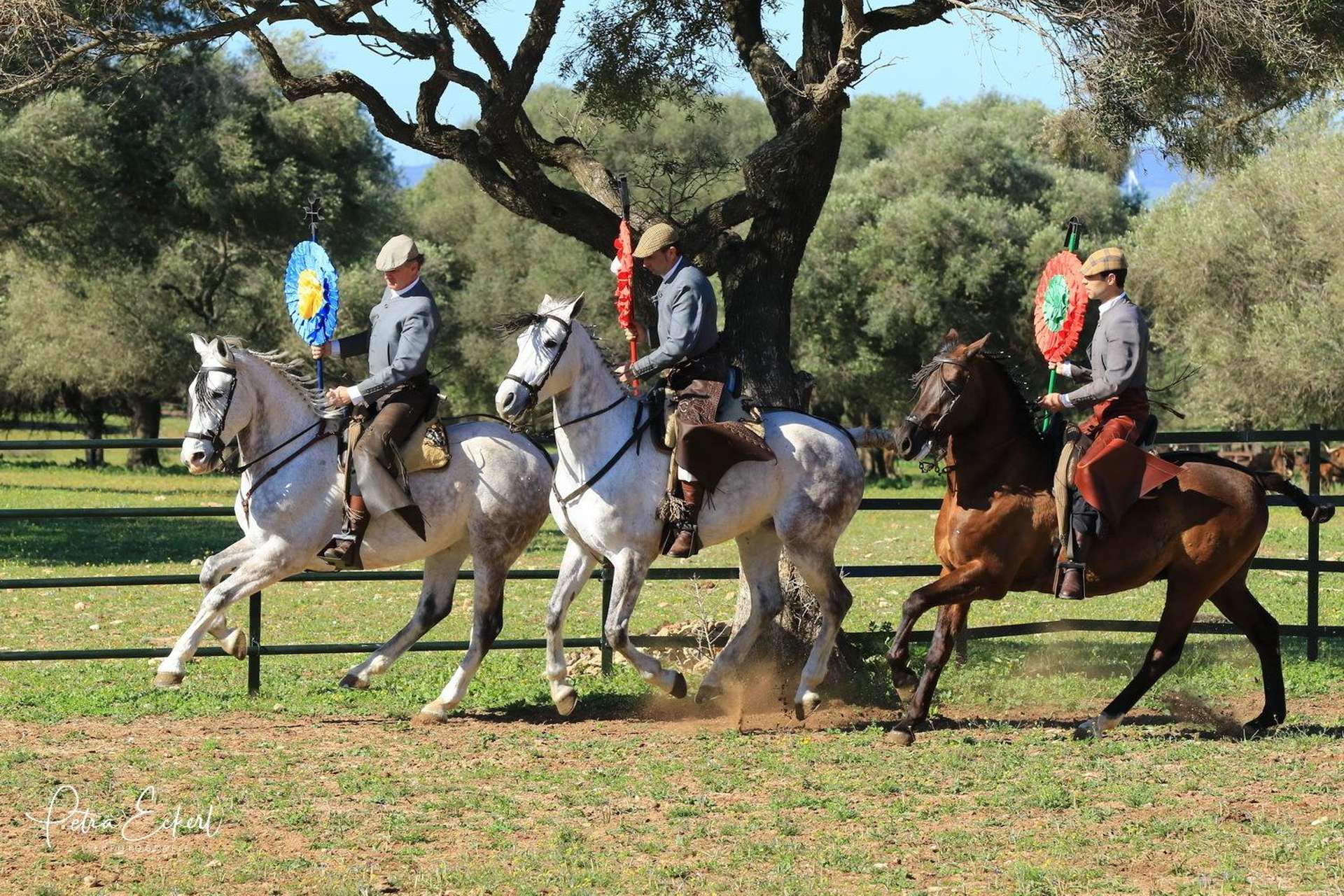
A Campo Abierto, Cadiz
In 2026, this remains the only show I’ve seen where the pura raza española shares billing with livestock bred for pure nerve. The bulls spend four years in open countryside before they ever step into that ring. That’s not decoration. That’s four years of muscle, instinct, and zero human contact shaping an animal that doesn’t perform – it reacts.
I’ve sat through polished dressage in Jerez and flamenco-infused shows in Cordoba. This is different. The dust settles on your clothes.
The sun hits hard if you pick the wrong seat. And when a stallion cuts across the arena to turn a bull, you understand why the Alvaro Domecq name carries weight in rural Andalusia.
What Actually Happens at A Campo Abierto
The show moves between two worlds. First, the cattle work: stallions, calves, mares, and foals moving through acts of bravery that feel less choreographed than negotiated. Then the horses shift into classical and countryside dressage – the same discipline you’d see in Jerez, but performed on ground that hasn’t been swept to perfection.
Countryside dressage, or doma vaquera, is the older cousin of the arena work. One hand on the reins. The horse reading cattle, not music.
Classical dressage shows you what the breed can learn. Countryside dressage shows you what it was bred to do.
Seating comes down to sun or shade. I’ve done both. Shade is kinder, but the sun-side puts you closer to the action. Either way, you’re close enough to hear the bulls breathe.
What lingers afterward isn’t the applause. It’s the silence between acts – the moment a Torrestrella bull and an Andalusian horse size each other up. That’s the spirit of rural Cadiz, and it’s disappearing faster than most visitors realize.
Yeguada de la Cartuja Tour with Carthusian Horse Show
The Yeguada de la Cartuja tour near Jerez de la Frontera is a guided visit to a working stud farm housing more than 200 thoroughbred Andalusian horses, where you see free-running colts, mares, and stallions before watching a dressage exhibition in the main arena.
I’ve been to plenty of equestrian shows across Andalusia, but this one hits differently. It’s not a performance built for applause. It’s a breeding operation that happens to let you walk through it.
The historic state of Fuente del Suero sits next to the Monastery of La Cartuja, and the climate and fertile lands there made it the undisputed center for breeding Jerezano horses back in the 15th century. That tradition never stopped.
The Carthusian lineage-Cartujano-is the purest branch of the pura raza española. What you’re seeing isn’t a generic Andalusian horse. It’s a bloodline that monks maintained for centuries, and the stud farm’s entire purpose is the preservation and improvement of that specific breed.
That focus changes the atmosphere. Nobody is selling you a show.
They’re showing you a legacy.
Walking through the pastures and seeing free-running Carthusian colts, knowing you’re witnessing the continuation of a 15th-century breeding tradition, is an incredibly humbling experience. The tour moves through different life stages. You see this year’s foals, then the mares, then the stallions kept separately. Each group tells you something about how the breed develops.
The guided tour covers the farm’s history and its breeding philosophy. Then comes the dressage exhibition in the main arena. It’s shorter than the big Jerez show, but the proximity changes everything. You’re close enough to hear the horse breathe.
What I remember most is the stillness of the place. No flamenco soundtrack, no costume changes. Just horses, handlers, and the work of keeping a breed alive. The Cartujano is the national pride of Spain, and after an afternoon there, you understand why that’s not marketing language.
The tour includes:
- Guided visit through the farm’s different breeding areas
- Free-running colts and mares in pasture
- Free-running stallions in their own enclosures
- A dressage exhibition in the main arena
- This year’s foals
Book ahead. The farm limits visitor numbers, and the tour runs on a fixed schedule rather than continuous entry. Mornings work best-the horses are more active before the Andalusian heat settles in.
You leave with a different measure of what these horses are. Not performers. Not athletes. A living archive.
Frequently Asked Questions
Most visitors ask the same practical questions before booking an Andalusian horse show: which venue suits them, when to go, and what to expect from the breed itself. The answers below consolidate what I’ve learned across years of attending performances from Jerez to Malaga.
I get asked about timing more than anything else. Jerez de la Frontera runs its equestrian calendar year-round, but spring and autumn offer the most comfortable temperatures for outdoor arenas. Summer shows in Cordoba and Cadiz can be punishingly hot, so I always recommend evening performances between June and September. The feria season in April and May adds street-level horse culture that no ticketed show can replicate.
Booking questions follow a pattern too. The Royal Andalusian School sells out weeks ahead for weekend shows, while the Yeguada de la Cartuja tour operates on a fixed schedule that rarely fills completely. For the Cadiz country show, I suggest reserving shaded seats early because the Andalusian sun does not negotiate.
People also want to know whether the Andalusian horse is suitable for beginners watching, not riding. The answer is yes. The breed’s temperament is famously calm and willing, which is why it dominates classical dressage and doma vaquera alike. What surprises first-timers is the horse’s compact build and elevated action – it looks smaller than a warmblood but moves with far more collection.
Here are the questions I hear most frequently, with the short version of each answer:
- Which show is best for a first-time visitor? The Royal Andalusian School in Jerez offers the most complete introduction to classical equestrian art.
- How long do performances last? Most run between 60 and 90 minutes, with the Cordoba flamenco fusion show clocking in at 70 minutes.
- Are shows suitable for children? Generally yes, though the Cadiz bull show includes moments of raw intensity that may unsettle very young viewers.
- Do I need to book in advance? For Jerez and Cordoba, yes. For smaller venues like Club Hipico El Ranchito, same-day tickets often work.
- What is the difference between Carthusian and regular Andalusian horses? The Carthusian line is a closed breeding population within the pura raza española, prized for its purity and consistency.
- Can I visit a stud farm without watching a show? Yeguada de la Cartuja offers guided tours that focus on breeding and daily life rather than performance.
- Is the Andalusian horse the same as a Lusitano? They share ancestry but diverged as separate registries; the Andalusian is Spanish, the Lusitano Portuguese.
One question deserves a longer answer: why does the breed carry such cultural weight? Because for centuries it was the horse of kings, bullfighters, and cattlemen simultaneously. That versatility is not marketing. I’ve watched the same bloodlines perform levades in a palace arena and herd bulls in open countryside within the same week.
The practical takeaway is simple. Pick one show that matches your travel route, book ahead for the big names, and leave room for an unplanned encounter – a feria, a training session, a stable visit. The Andalusian horse rewards both planning and spontaneity.
At the end of the day…
I’ve watched Andalusian horses perform in gilded arenas, dusty village streets, and working ranches across Spain. The one thing that stays with me isn’t the choreography or the costumes. It’s the feeling that I’m witnessing something alive, not a museum piece.
Here’s what I want you to remember:
- Jerez de la Frontera is the beating heart. The Royal Andalusian School of Equestrian Art delivers the full spectacle: classical dressage, Doma Vaquera, carriage driving, and work in hand. The VIP upgrade gets you into the stables and saddlery, where the real magic happens before the show.
- Cordoba and Malaga offer the flamenco fusion. The Royal Stables of Cordoba pair a 70-minute performance with 16th-century architecture. Club Hipico El Ranchito in Torremolinos has run its 20-horse equestrian ballet for over 25 years.
- Cadiz and El Rocio show the rustic soul. The Alvaro Domecq family’s country show at El Carrascal mixes Torrestrella bulls with countryside dressage. El Rocio’s sandy streets, where horses have priority over everything, feel like stepping back in time.
- Yeguada de la Cartuja is for the purists. More than 200 Carthusian horses, free-running colts, and a dressage exhibition on the farm where the lineage has continued uninterrupted since the 15th century.
Pick one experience and book it before you land. The Royal School sells out during feria season, and the Cartuja tour runs on a fixed schedule. I’d start with Jerez if you want the grand ballet, Cadiz if you want raw countryside energy, or Cordoba if flamenco is your thing.
The Andalusian horse isn’t just a breed. It’s a living thread running through Spanish culture, and once you’ve seen it perform, you’ll understand why the Spanish call it pura raza española with such pride.