
You don´t want to miss the amazing Cordoba mosque-cathedral.
And even though it is a major sight there is plenty of space to move around without being bothered by the many tourists.
It is outside the mosque-cathedral you need to be aware of crowds and tourist traps.
Everything around the mezquita is very touristy and expensive. Close your eyes and move far away from the mosque-cathedral fast.
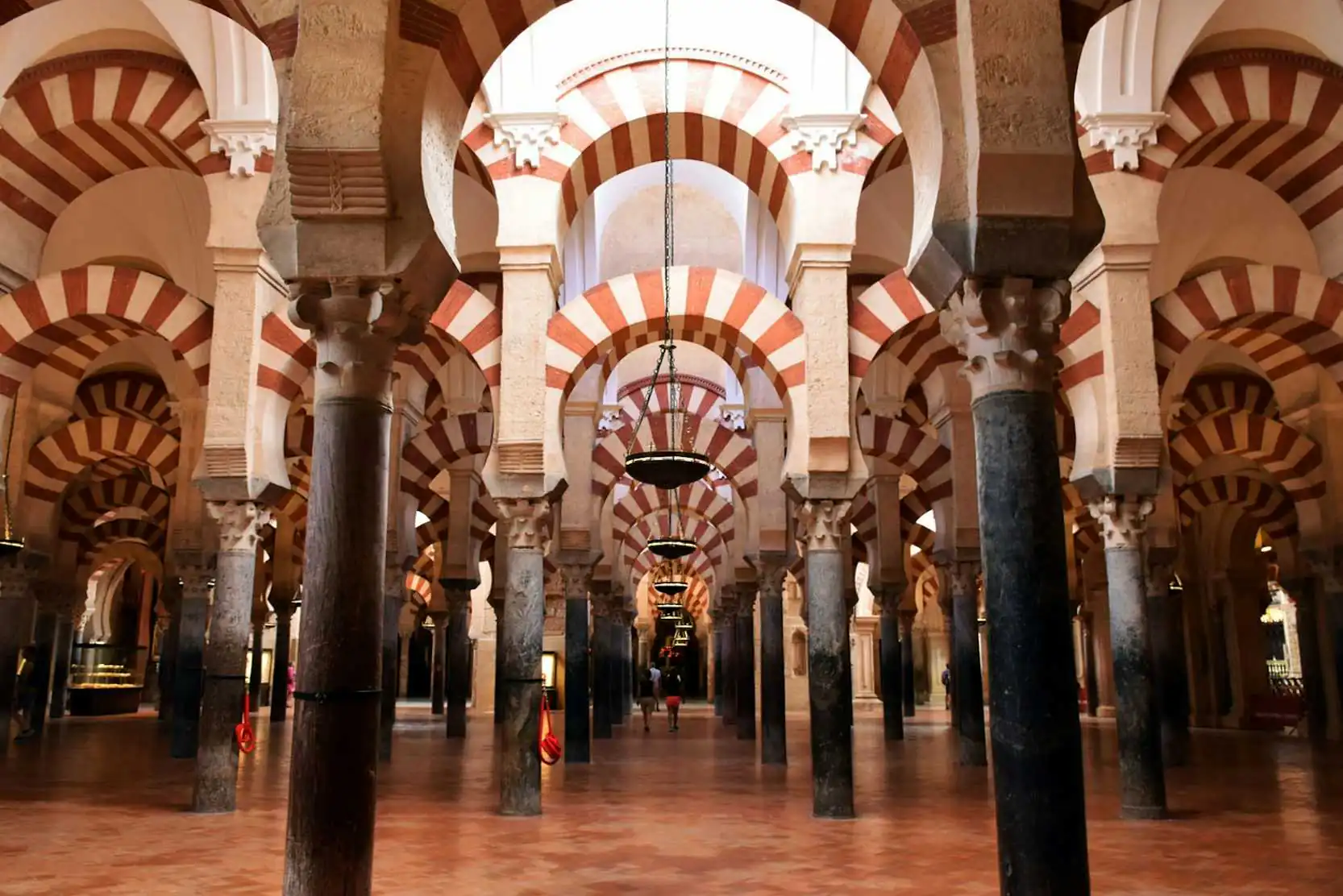
The Cordoba mosque-cathedral
Also on the impressive roman bridge Puente Romano there are lots of tourists. Also here there is plenty of space, so not a problema.
The other spectacular thing to see in Cordoba is the festival of flower decorated courtyards; Los Patios de Cordoba.
The festival is in May, but many patios open all year for visitors. Take a guided tour or walk the roundtrip to them yourself.
Try the local speciality: Snails in broth. It is actually surprisingly good, even if you never tried snails before.
Cordoba is easy to drive and to find parking.
Try the local guided tapas tour, experience a flamenco show or see the fantastic Cordoba Ecuestre horse performance.

Michael Madsen shares how to get the best experiences in Cordoba
See aso my articles about:
Tapas in Cordoba
Flamenco show in Cordoba
Horse show in Cordoba
I found myself in the Cordoba mosque-cathedral at midday in the height of July and spent about 20 mins playing with my cell phone. Big mistake. No tour guide, no idea what I was looking for, no plan.
All those columns were a bit too much. So much history around me, but I couldn’t begin to fathom its meaning.
I walked away thinking I had been privileged to see something magnificent, but knew little about it.
It goes without saying that you should know something about the building before setting foot inside. A good quality tour can tell you about almost every aspect of the building, from the characteristic arches, to the remains of a Visigothic church directly underneath, and the cathedral constructed in the middle. All of this information is completely lost on you if you simply stroll around this massive, very ancient structure.
Entrance to the mosque is between 15 and 40 euros, although the first hour each day (8:30-9:30 am) Monday to Saturday is free. Although very appealing, I have taken advantage of this once and was glad I didn’t make a habit of it. It is very quiet, but again there is nobody to tell you anything about what you are seeing and as a result you feel the need to speed through before the rest of the visitors are admitted. Given the richness of the site this would be very little reward for your troubles.
You couldn’t ask for much better weather and fewer people than in April, May and September to October. I can testify that it was very unpleasant to be out in the courtyard during the heat of an August day, with the stone surface radiating heat back to scorch your legs. If at all possible try to schedule your visit at this time.
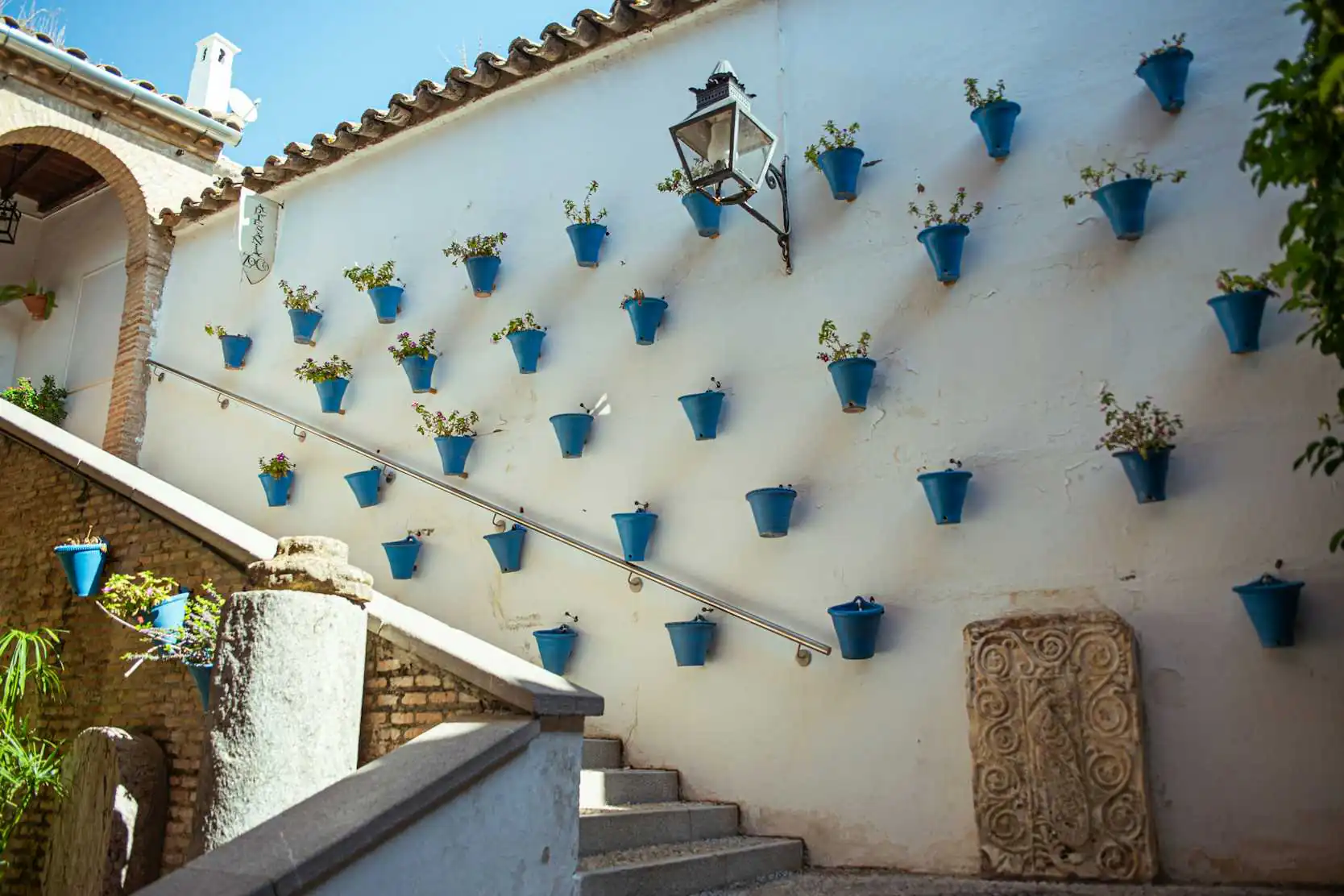
Los patios de Cordoba
Below are details of some of the tours available in Cordoba, both ones I have done and ones I wish I had known about. There are a number of tours available of the Mezquita, tours of the Jewish quarter and Alcazar, day trips to Medina Azahara and a cycle around the city.
- Guided tours of the interior of the building
- Combined tours of the Mezquita, Jewish Quarter and Alcazar
- Excursions to Medina Azahara
- City tours by bus or bicycle
I hope you can learn from my mistakes and make the most out of your visit. That is certainly my intention with this guide.
Mosque-Cathedral of Cordoba: Guided Tour
If you don’t go on the tour you’ll see one of the most stratified buildings in the world, but have no appreciation of any of its strata. I think the only way to comprehend the sequence of events and transformations to give rise to the current structure as a Visigothic church, then a mosque, then a cathedral, is to go on one of these tours. I’ve seen both. Big difference.
I noticed that many of these were old Roman columns that had been re-used. I don’t think I would have noticed this feature on my own and it completely changed my view of the mass of columns. It was as though they were proud of their history and wished to make this known.
Yes. The site of the Visigothic Basilica of St. Vincent became the site of the first mosque, built by Abd al-Rahman I. It was enlarged considerably during the reign of Almanzor and became the greatest mosque of the West by the end of the 10th century.1 A knowledgeable guide will weave these events into an interesting history, rather than merely reciting dates and events.
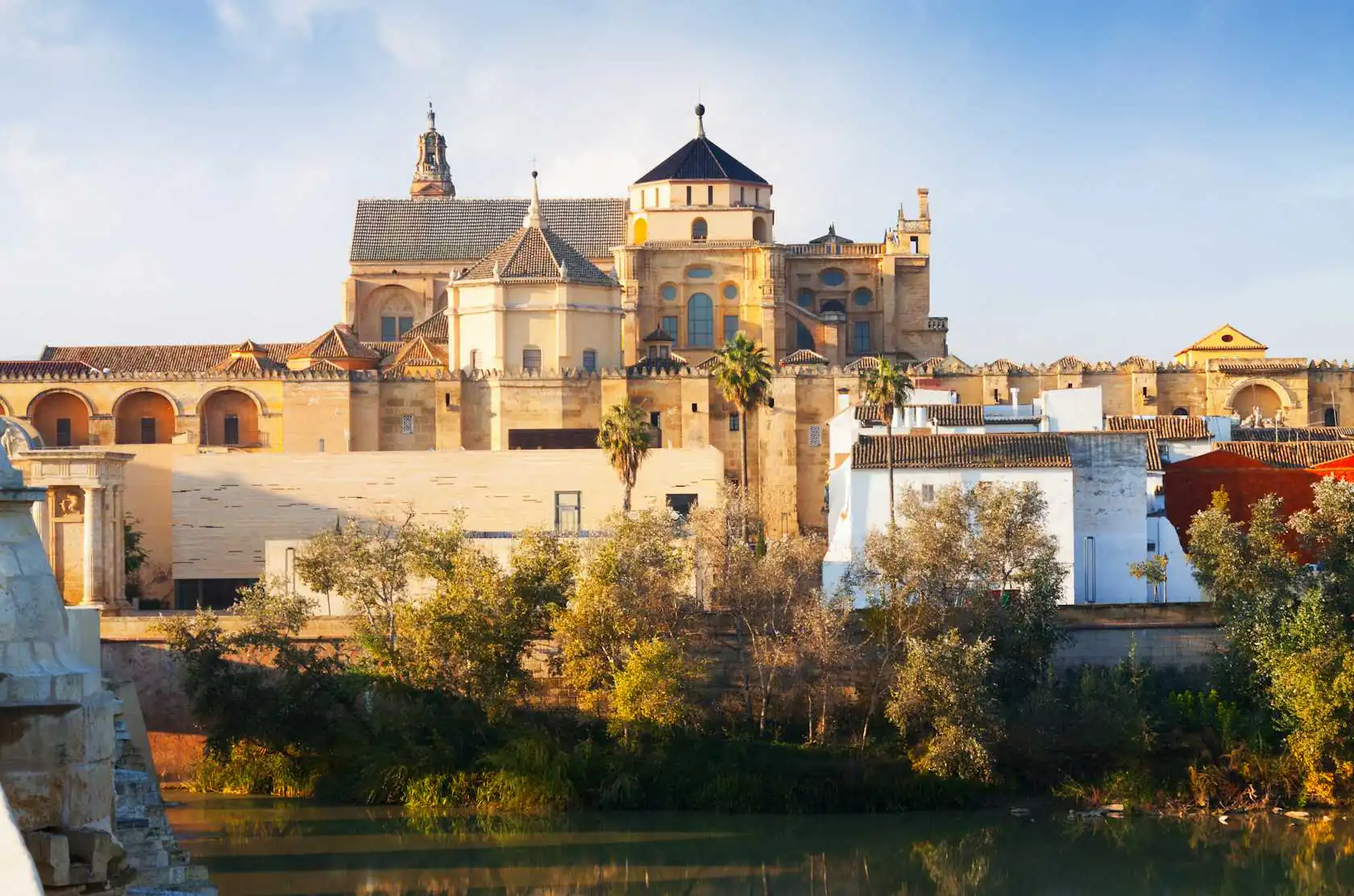
The Cordoba mosque-cathedral seen from the roman bridge
What a Guide Reveals That Your Eyes Cannot
Horseshoe arches would be nice to see, but the tour guide goes into more detail, explaining their usefulness and symbolism. So these were no mere embellishments.
They managed to solve an engineering challenge, producing a repeating pattern which retains its hypnotic effect. One outstanding piece is the mihrab omeya. It is one of the finest examples of Islamic art, most visitors will take a picture of it without any knowledge of its meaning.
Standing before you, a guide will explain about the skill involved in producing this work, its gold mosaic features, and some of the political symbolism.
From this point the transformations are fascinating and bizarre. In the 13th century it was rededicated as a Cathedral. However, the existing Mosque was left intact.
A nave was constructed in the Gothic style, followed by the construction of Renaissance- and Baroque-style chapels within the structure of the building. One can imagine how disorienting it would be to walk through this building without any background information.
So, when accompanied by a guide it’s an intentional exchange between two belief systems. This aspect tends to be overlooked.
The Courtyard and the Bell Tower
As beautiful as it is, the Patio de los Naranjos dates back to the initial construction phase of the building in the 8th century. According to my guide, this area would have served many purposes including washing prior to prayer, assembly of the general population, and holding court.
Although there are now orange trees, the plot of land dates from the time of the mosque. An ancient minaret has also survived to this day, nestled within the bell tower.
There you can see the Muslim tower contained within the Christians’ bell turret. It is a miniature representation of the entire edifice.
This is what I would say to another visitor to book a guided tour, rather than an audioguide. With an audioguide, you just get facts. With a guide, you’ll get arguments.
She took issue with the suggestion that the cathedral “conquered” the mosque, maintaining rather that it safeguarded it.
This point of view is well worth paying more money for.
- Visigothic Basilica of Saint Vincent is older than the mosque.
- It was originally built in the 8th century by Abd al-Rahman I.
- During Almanzor’s reign the building was greatly extended so that by the 10th century it was the largest mosque in the West.
- 13th century Christianisation superimposed various styles, including Gothic, Renaissance and Baroque.
- This mihrab is one of the finest examples of Omayyad art.
One question remains with you once the tour is over. If so much can be found within one structure, how much more may be found elsewhere throughout the city? Other sights around the city now appear to be other volumes in this continuing saga.
That is only the start of a much longer trek.
Guided Cordoba Highlights Walking Tour
I signed up for a four-hour city walk and managed to see several key sights all linked together. So I saw the mosque and cathedral, the Jewish quarter, the synagogue and the Alcázar. All strung together, this seemed better than seeing three of these individually, each to themselves.
It starts at the Mezquita and spreads from there. I’m glad my guide didn’t feel compelled to go through all of the arches, nor the mihrab. She took those as her starting point and built on them.
I continued on foot through the nearby Jewish district. It was interesting to note the blend of all these varied influences, something I would probably not have appreciated had I just walked around at my leisure. Many of the little streets retain the names of various crafts.
Another synagogue, known as the Souk, is only a few minutes away. This one is quite small and is one of only three remaining from the medieval period in Spain.
That fact hit home more strongly after I’d just exited a building which had been a mosque and was now a cathedral.
What the four hours actually cover
- The Mosque-Cathedral itself, with entry included
- Close to the old city lies the Jewish Quarter.
- The Souk, Cordoba’s most famous synagogue
- All of the buildings and gardens of the Alcázar de los Reyes Cristianos.
To my surprise, it was the Alcazar that impressed me most. I only expected to pass by some walls on our way through this area. But our guide was able to illustrate various periods in the history of the city all within one small courtyard.
Roman foundations. Visigothic stones.
Baths characteristic of the Islamic world. Rooms surrounding the throne as found in Christian churches. Behind these is a series of gardens, many containing orange trees and long narrow basins.
As the tour continues on from there you’ll find yourself with more leisurely pace. There’s no need to hustle to the next sight.
This site has seen the rule of Roman governors, Moorish caliphs, and Christian kings.
Four hours seems like quite a length of time, but it goes very quickly. There is very little uphill or down, with lots of opportunities to rest.
Although I had visited the Mezquita alone the previous day, I felt afterwards that this tour had shown me many more features of the building.
Of course, there is more beyond the mosque, with numerous streets radiating out. All these have their own history, and who originally inhabited them.
This is some distance away from the centre of Cordoba, so would require another visit. However, this walk will undoubtedly whet your appetite and provide some background information about the ruler, before reaching his palaces.
Medina Azahara: Guided Tour
Although I am sure I could have spent some time gazing at these remnants, I decided to employ a guide. I feel this was very worthwhile, as he provided valuable information about both the extent and splendour of the Caliphate. All of this information proved extremely useful when touring the Mezquita.
Approximately 8kms from the city. Although this would take very little time to cover, there is a large time gap to consider.
It was founded in the 10th century by Caliph Abul-Rahman III. As you can imagine this in itself means very little. However, after viewing the excavated remains of the principal palace, the significance of its construction becomes clear.
Clearly this was intended to be a very opulent and imposing structure, to display the opulence and strength of the Caliphate, to act as a new capital and thus bolster his position.
What the ruins actually reveal
A nice tale concerning his homesick wife bringing cherry trees from her native country, but it would appear that the truth lies further down.
As well as the palace itself, there are many other areas under excavation, namely a mosque, various noble homes, offices and other buildings serving the needs of the inhabitants. As you pass along each area it is easy to imagine the functions performed by these different areas.
Clearly much of the wealth and know how required to carry out the continual additions and improvements to the Mezquita would have originated here. So it is very interesting to see these two contrasting aspects of the same era.
It was interesting to try and picture some of these buildings and rooms, such as the audience hall, in which the Caliph would receive visitors. It would be some time before the construction of the Alcazar for the Catholic Kings, but it was clear that it would take some considerable feat to eclipse this.
It was only 70 years after its completion that the Berbers sacked the city. It is significant that so little time elapsed before its demise.
So the city only survived a little while longer than the rule of its creator and all aspects of life at that time can be seen at the site. With the help of a good guide you can be shown all the areas plundered, as well as those that escaped. So this hill becomes much more interesting from a political viewpoint.
You really should take a guide with you. There is very little information provided on the site itself, and much of the area to take in. A knowledgeable person is able to give you a brief summary of the city’s history and tie this into the wider history of the Caliphate.
All these features make this relevant to knowledge of the Mezquita.
- Palace and Mosque, and many other buildings.
- Built by Abd al-Rahman III around 1000 A.D.
- Ransacked by Berbers 70 years after completion
- As a demonstration of his wealth and strength, as well as to provide a residence for a wife who missed living in her native city.
Approximately 20 minutes by bus back to Cordoba. All the time I was considering the many rows of columns. More than just an architectural feat, they represented the might of this Caliphate, which reached its peak here.
Alcazar of the Christian Monarchs: Guided Visit
Prior to visiting the Alcazar I felt I knew all about the history of Cordoba. I had gained some knowledge of it from seeing the Mezquita, but seeing the Alcazar gave me a whole other aspect, which I found very interesting.
To appreciate how much the Christians altered Cordoba after taking over you could do no better than take a tour of this area. It has been many things: the residence of Kings, seat of the Holy Office, and prisons.
All manner of functions could be carried out here within these walls.
My guide highlighted many features which I would otherwise have overlooked. These range from mosaics and frescoes to views from various towers and parts of the Palace. All these would have afforded the Kings and Queens the opportunity to salute their subjects.
Walking around the gardens it was easy to picture them standing on the tower and greeting the masses, so very different from their predecessors at Medina Azahara.
And finally a few words about the gardens. Many canals, orange trees and the avenue lined with statues of various Kings and Queens who spent time at the Alcazar. I walked slowly along this.
There is one to represent each dynasty to rule there, so each has a name attached. Of course there are lovely gardens.
It’s a timeline in stone and citrus.
Some areas will be shut during my visit as work is ongoing. Fortunately these have been replaced with visits to the gardens and Columbus statue. I then took a short visit to see the Baths of the Caliphal Alcazar.
As can be seen by this brief description there is plenty of Islamic influence evident within a mainly Christian building.
As you would expect it consists of several superimposed levels.
I think I spent around an hour and a half here. Although shorter than the time I spent in the Mezquita it was well worth the while. I enjoyed learning of its place in the development of the town and surrounding area. Fortunately I was shown new aspects to it by my guide who had covered most aspects previously.
Following on from this, Viana Palace gave me an insight into another aspect of Cordoba, namely its homes. So it was a natural progression to follow. So once again there was a new area to learn about and discover.
Viana Palace: Guided Tour
By restricting itself to one family’s taste and preferences, this house is particularly interesting. It is possible to get an idea of how well-to-do Cordoba residents lived in the 15th century. As well as many old pieces of furniture, hangings, pictures, and weapons, there are 12 beautiful patios to see. These make excellent use of both Roman and Islamic elements.
My guide hurriedly took us around the house and stopped me to admire a fine piece of hanging. We then went out onto the first of these lovely sunny patios.
Here we were surrounded by plants, fountains, and other delights. I could see the remains of aqueducts supplying the fountains, as well as many Islamic features surrounding the doors.
- All aqueducts supplying the fountains date back to the Romans
- Predominantly Islamic decoration and planting
- Each is used for a different purpose around the house, eg. service area, area for receiving visitors etc.
I found this system very convenient for seeing a number of sights within one afternoon, although there would be no substitute for standing in one of these beautiful patios, listening to a guide tell you about the reason for the offset position of the well. It so happens that this would be beneficial, as it would minimize the exposure to the sun. Hence this function, common to the Romans, was continued by the Muslims.
It seems evident that the houses of Cordoba reflect many of these features. Far from being merely ornamental, the patios serve as a form of passive cooling, as well as areas for relaxation and entertainment. Each house would have its own small garden.
Hop-on Hop-off Bus Tour
Of course how much you wish to see over the course of a day is up to you, however taking advantage of this service would seem an ideal solution. Not only would you be able to visit places such as the Mezquita at your leisure, but you could also change buses and continue to other parts of the city. A 24-hour pass entitles you to both routes, allowing you to hop off outside each of the main attractions. Obviously you will want to listen to the commentary throughout the journey, as you will learn a lot simply from listening as you sit in the cars.
I enjoyed riding to the Jardin Botánico, where my children were able to play, and then continued to the Alcázar. Clearly there are great benefits to be gained from this. Although the whole old town is quite small, it can be very hot, and exhausting to attempt on foot. You would find yourself stopping frequently at each of the places you wished to see.
There are a number of other attractions to be found along both routes, such as the Jardin Botánico y Zoológico, the Ciudad de los Niños, and the Royal Stables in the nearby San Basilio. Both of these sites form part of the UNESCO-listed area. You could easily include a trip to the Alcázar de los Reyes Cristianos as well.
As previously mentioned, 2 free walking tours are included with purchase of a ticket. One to the Jewish area, the other to some of the markets. Clearly both would complement the attractions visited on the bus.
Thus you benefit from transport, and at the same time enjoy the more in depth information offered by the walking tours.
I would be inclined to think some people may feel taking this form of tour would be somewhat lazy, however I feel you learn a great deal. You may be interested to discover some of the reasons why certain buildings and areas exist, and how the city has developed over the years.
With knowledge of these aspects, you begin to appreciate the sites that you go on to see.
I don’t think this bus tour is a substitute for a lengthly walking tour. Rather it is an excellent way to get around and between all the other interesting places to see. I would still highly recommend hiring a historian to accompany you through the Mezquita itself. For all the rest this was by far the most convenient method.
You can save about 30 mins of walking under the hot sun. And I think this is much more significant a factor to visitors than they are willing to concede.
Guided Bike Tour
One of the best ways to see some of Cordoba’s most interesting areas is by bicycle with a local guide. This tour will include the Mezquita, several small plazas and approximately 12 patios, over the course of 2 hours. Obviously much quicker than foot, but more detailed than taking the bus. With very little elevation gain, it is suitable for all levels of cyclist.
Without looking at my map, I had a pretty good idea where things were around the city. Just this one piece of information affected the way I traveled about the city.
My guide pulled up to a minuscule courtyard, which I would have easily ridden by. No signage or kiosk, just a slightly ajar gate. There was one tree producing oranges, standing over broken tile and three spare seats.
The courtyard behind the house gave me a sense that I wasn’t touring another city, but visiting a real community. The tour guide even knew the homeowner’s name.
That would be the difference between routing and recommending.
- See the exterior of the Mezquita now and return to see it with a guide at some stage.
- Ride through the cobbled alleys of the Jewish Quarter before all the tour buses arrive.
- You’ll weave your way around courtyards and other narrow areas inaccessible to buses.
- Discover which eateries and pubs offer good value, rather than the more obvious attractions.
I think this bike tour would be a great addition to seeing the Mezquita up close, but would certainly not preclude doing so. It gives an interesting perspective on the surrounding area. You see all of the winding streets and alleys that lead up to it, the decreasing width of these streets as they head towards it, and you see the tower of the former church well before arriving at its entrance.
This impression stayed with me, and I recollected it when I was among the pillars of the forest.
I felt that the building would be more impressive to me now that I had worked my way to the point of being there.
There were many suggestions offered by locals. I was told about a bar serving excellent salmorejo, a good place for pestiños after lunch time and a nice terrace to enjoy from sunset. I jotted all 3 down.
There were two others that were amongst my top meals of the week. You’ll hear lots of information on the bus tour.
Any good bike tour will provide a handy reference.
Unless you’re averse to cycling in general and/or it’s going to be 40 degrees, try to do one as soon as possible. Not only will you be able to get your bearings quicker than poring over a map, you’ll gain an understanding of the relative positions of all the sites to the Mezquita.
I was told that there had been walls running down one of the current bike lanes. So there I was, happily cycling along the very spot where walls would have been. No wonder Cordoba is rich in history!
Finally I would like to say this…
Just turning up unprepared at the Mezquita would result in gazing at all those arches and columns, none of which would make much sense to you. But with a knowledgeable guide, you begin to appreciate why there are so many columns, what additions have been made (to name just a few), and about the carving out of the Cathedral.
All I would recommend if you’re only going to do 1 guided tour of places of interest, is to try to do this one. I was amazed at how much more knowledgeable I felt after listening to the guide. Also to learn about the Patio de los Naranjos and how it dates back to the 8th Century.
So to summarize:
- 1. Try to do this as the first guided tour. Although entry will cost around €15, I’d highly recommend paying extra for the guide.124
- 2. Try to visit at first opening time (8:30-9:30 Monday to Saturday) when it’s free. I visited at this time 1 morning to enjoy some peace and then paid entry to go around with a guide.123
- 3. Try at least 1 other means of seeing Cordoba. I found the hop on and off very useful, especially if you want to re-visit somewhere you may have been in too much of a rush. Alternatively do the bike tour to see the Jewish quarter and some of the patios.
- 4. Don’t neglect the “smaller” attractions. I would allow at least half a day to see both the Viana and the ruins of Medina Azahara. Only 70 years after its construction, this town was destroyed by the Berbers, and I can’t imagine anything more evocative.
So now, book online! Book as soon as possible if you plan to visit in April, May or October. And try to do at least 1 guided tour on the morning of your arrival. You’ll soon see why this should feature prominently on any trip to Cordoba.
I’ve been guilty myself of simply taking pictures! Try and allow your guide to explain the significance.
Frequently Asked Questions
What are the opening hours of the Cordoba Mosque-Cathedral?
The hours vary depending on season and type of day. Usually it will be open 10:00-19:00 (summer) and 10:00-18:00 (winter) on weekdays. It’s best to check what the opening hours are on the day you want to visit via their website.
How much does it cost to enter the Cordoba Mosque-Cathedral?
Entrance fees vary but you can expect to pay between €15 and €45. There are concessionary fees applicable to certain people. As always, it’s best to check these before visiting so you can budget accordingly.
Is there a free entry time for the Cordoba Mosque-Cathedral?
If you’re able to get there between 8:30-9:30, Monday to Saturday, you will be able to enter for free. However this will only be applicable to individuals wishing to visit quietly. So if you’re after a quick and free visit to see what all the fuss is about, then this would be ideal.
What is the best time of day to visit the Mezquita to avoid crowds?
To try and avoid other visitors to some degree, you may wish to try to visit as soon as it opens, or a couple of hours before it closes. You should find fewer people at either end of the day.
Do I need to book tickets in advance for the Cordoba Mosque-Cathedral?
I would advise purchasing your tickets online as much as possible, especially between April and May, and October. This will allow you to skip the queue.
Sources
- Mosque-Cathedral of Cordoba Tickets & Hours 2026, contartecordoba.com
- Cordoba Mezquita Tickets and Opening Times, explorecordoba.com
- Hours and Entrance Fees of the Mosque of Cordoba, tourmezquitadecordoba.com
- Tickets and opening times, mezquita-catedraldecordoba.es
- alisononfoot.com — vertexaisearch.cloud.google.com
- How to visit the Mosque Cathedral of Cordoba free of charge, esncordoba.org
- Inside the Mezquita of Cordoba — travelchoreography.com
- Cordoba Mosque-Cathedral: Best Time to Visit, thewildlifediaries.com
- Information About Visiting the Mezquita-Catedral de Cordoba, ouradventurejournals.uk
- Best Time to Visit the Cordoba Mosque, mezquitatickets.com
- Best Tips for Visiting the Mezquita, 2025, european-traveler.com
- Cordoba Mosque-Cathedral tickets — mezquita.cordoba-tickets.es
- 7 Tips for Visiting the Mezquita-Catedral, thevivalavita.com
- What to Wear and other Information, clevertourists.com
- Rules for Visitors, cordobamezquita.org
- Guided Tour of the Mosque-Cathedral, discovercordoba.com
- Guided Tours of the Cordoba Mosque, mytoptour.org
- Cordoba Mosque Opening Hours — tickets-cordoba.com
- Getting There, noma.ma
- Tips for Visiting the Mezquita, Cordoba, theorangebackpack.nl